Orange and green

This week, among other things, I read a book from Japan, one from Korea and one from America.
The Final Six by Akinari Asakura
Shogo Hatanu has finished his studies and is looking for work. In Japan, this is a deadly serious matter. The competition is fierce and only a handful of candidates are invited back for a second interview at a prestigious tech company in Tokyo. In the end, only six remain out of thousands. Only one can be hired, and they are informed that their final test will consist of a meeting during which they must debate for hours and ultimately choose the winner themselves by voting. You may not vote for yourself.
Hatanu is highly ambitious, though clearly not as ambitious as the candidate who has envelopes containing each applicant’s deepest secret delivered to the boardroom. Each envelope is addressed to one of the candidates and contains incriminating information about another. After the first two envelopes are opened, chaos erupts. The most promising candidate impregnated a girl at university, insisted on an abortion and then abandoned her. Another bullied a boy at school until he took his own life.
Shogo honestly cannot think of any great scandal in his own past. He is in love with another candidate, Shima. He begins to suspect that she is behind the envelopes, but nevertheless votes for her. Distrust and cruelty become the order of the day.
Interspersed with these events are interviews that Shima conducts years later with the human resources manager and the surviving candidates. The person exposed as the one who planted the envelopes has apparently died. All manner of information comes to light. The reader is left wondering: who got the job, who was guilty, and who is dead?
I do not want to reveal any more, but it is tremendously suspenseful and, as seems characteristic of Oriental novels, deeply cynical about human nature. The author is especially, like me, cynical about the process of job interviews and appointments. Candidates lie shamelessly and companies lie in return: “It’s a sick cycle. Students lie to get into companies. Companies lie to reel students in. HR can’t actually judge anyone, so idiots slip through.”
It is a “runaway Japanese bestseller”.
The Final Six by Akinari Asakura is published by Sphere and costs R524 at Exclusive Books.

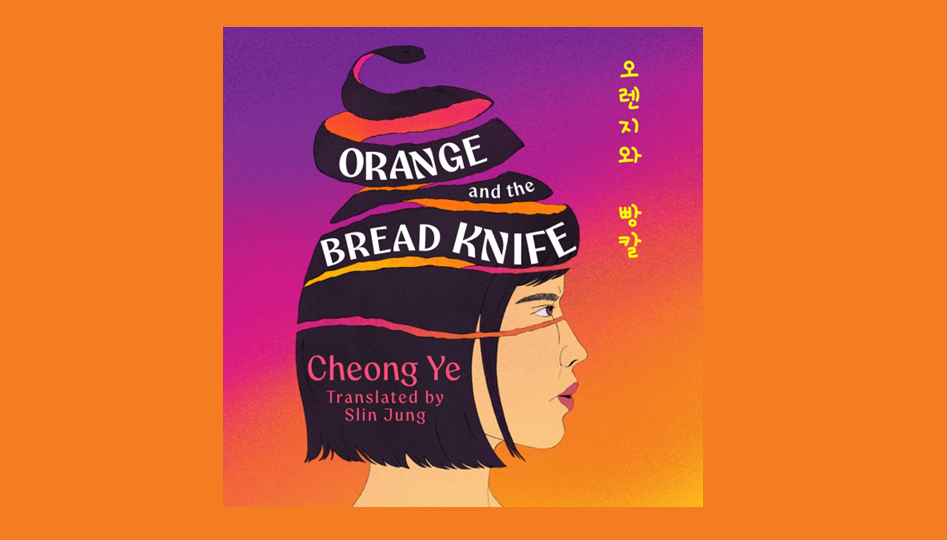
Orange and the Bread Knife by Cheong Ye
The Korean book (translated into English by Slin Jung) is one of those novels that plays tricks with your mind and bats your emotions back and forth like a game of table tennis. It is truly strange, in the way I have come to expect from Korean literature. The entire novel consists of an internal monologue. The narrator wrestles with herself, agonising and endlessly weighing everything up.
Yeongah wants to be a good person. She wants to be like her devout friend Eunju. Eunju wants to save the entire world and be the most irreproachable person on earth. She donates to charities, signs petitions, attends protests, eats only organic food and worries about the environment. Unfortunately, she is also extremely prescriptive and expects the same behaviour from Yeongah. Every day she sends her hundreds of WhatsApps with links to worthy causes.
Yeongah tries to donate and help wherever she can, but still feels unworthy and constantly apologises. Eunju enjoys it when she apologises.
Yeongah’s boyfriend also makes her feel inadequate and like a bad person. He is the best person on earth, doing everything he can to make her happy and behaving with complete selflessness. This makes her feel selfish and guilty, and she constantly apologises in that relationship as well.
She is a kindergarten teacher, and there is one difficult child who throws furious tantrums and screams deafeningly. He repeatedly kicks her in the spine, yet the headmistress expects her to apologise to him as well. She experiences no joy in her life and becomes increasingly depressed.
Then, at her boyfriend’s insistence, she visits a state-funded medical institute that treats people free of charge as part of an experiment. Under local anaesthetic, they perform a minor procedure that stimulates a particular part of her brain. The effect is supposedly only going to last for seven days.
After the procedure, Yeongah is constantly furious. She does exactly as she pleases—telling her friend that she hates her and treating her boyfriend coldly. Then she starts to laugh. She rolls around on the floor laughing at the freedom she suddenly feels from no longer caring about being a good person. She eats whatever she wants. Her only fear is that this lack of self-control and inhibition is temporary and that she will continue to long for that freedom afterwards: “I made the choices I made because I wanted to be a good person, but where did those choices lead? A life where I had everything I never wanted.”
This is how she describes happiness:
“Like an insect with its head already swallowed, realizing its limbs were still free. Like a fish thrown in water who had just realized it had gills. Like a child at the doors of an empty school finally remembering that the holidays had started.”
Read for yourself what happens.
Orange and the Bread Knife by Cheong Ye is published by Headline Publishing Group and costs R462 at Exclusive Books.
The Final Target by Nora Roberts
Because I feel at home in the world of books, I enjoy reading about writers. Arden Bowie is a young author whose books sell like hotcakes. By coincidence, she is stunningly beautiful, like all the heroes in Nora Roberts’s novels: tall and slender, with red hair.
She becomes the target of an unstable man who stalks her and lies in wait for her everywhere. In his mind, they are destined to be together. His plan is to take her to a remote mountain cabin and live there in isolation. She will work like a slave and serve him. At least she will be allowed to keep writing until the children start arriving—he wants a dozen.
One evening, he appears at her apartment door carrying a huge bouquet of flowers. She opens the door to tell him to leave, but he slips inside. When she resists, he hits her, throws her to the ground and begins to rape her. Fortunately, her neighbour hears the commotion and comes to investigate. The unbalanced man, Dustin, flees.
He is arrested, but his family has endless wealth and influence, and he avoids prison, being sent instead to an institution for five years. He counts the days and dreams of revenge—and still dreams of the little house in the mountains.
Meanwhile, Arden tries to get on with her life. She moves to the countryside, where she settles into a lovely home. Coincidentally, the police chief and local carpenter is impossibly attractive, and there is a spark between them. Meanwhile, the five years are almost up and the insane rich boy is on his way to find her. Read it for yourself.
Nora Roberts writes many books and, yes, there is a formula. The good people are beautiful and endlessly loving. The villains are rotten to the core. There is trauma and there is romance, and the reader knows which will triumph in the end.
I have distant relatives who read nothing but her books. They do not read very quickly, and she publishes several books a year. If that is your thing, it is masterfully executed.
The Final Target by Nora Roberts is published by Piatkus and costs R347 at Graffiti.