At the end of the world

This week I visited the future, and it looks bleak. As Leonard Cohen said: “I have seen the future. It is murder.”
I always thought I wasn’t particularly fond of dystopian fiction. It’s so inhospitable and hostile at the end of the world, when the hourglass has run out for humanity. When the earth, abused and raped by humankind over so many millennia, suddenly shakes us off like troublesome flies.
Here is a futuristic novel that haunted me like a nightmare and that I could not put down. I’ll read anything as long as the characters become part of my nervous system and the writing is clean and spellbinding. Then I surrender myself to textual textasy and explore horizons I didn’t know existed.
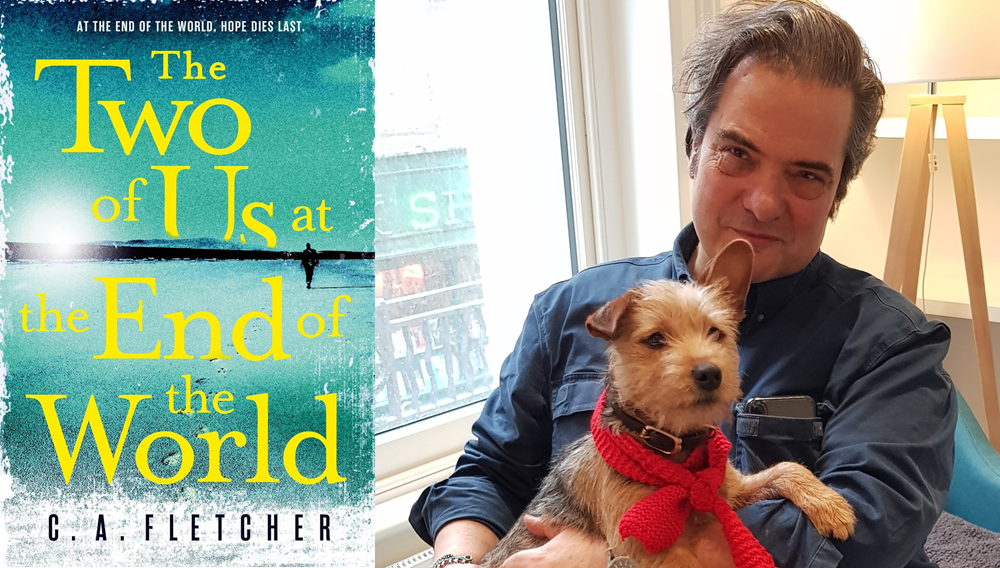
The Two of Us at the End of the World by C.A. Fletcher
Charlie Fletcher is a British screenwriter and author, among other things the writer of the Stoneheart trilogy (young adult novels). This novel was my first encounter with his work.
There are two storylines, two sets of characters, roughly 200 years apart, and towards the end they sort of meet. As often happens with dual timelines, I prefer one of them, become absorbed in it and get annoyed when I suddenly have to clamber back into another scenario and another time. But gradually the storyline I liked less also began to fascinate me, because of the characters.
It begins in Year Zero, with G-Day on the Hebridean islands of Scotland. A boy and a girl are on the beach when the announcement comes from the World Health Organization: it has become clear that humans have simply, brutally, stopped being able to have children. Now the countdown to the end begins: approximately ninety years for the last generation of naturally born children to grow old and die.
The girl tells the boy that at least the dinosaurs didn’t see the end coming.
Then we meet Mouse, the character who captured my imagination more than any other. It is the year 201 AD (After G-Day). A handful of people can still reproduce. The earth is sparsely populated and devastated.
Mouse is a teenager. His only-other is Cat. She was six and he was a baby when she picked him up and fled with him through the night. His mother, dying of the Great Cough, had asked her to look after him.
Now they are grown up and have a holy terror of the sea, because that is where the strangers came from who brought the deadly cough to their little group of people. Cat and Mouse live in an abandoned bunker with a hidden door, and all they have is each other. And books. Cat taught him to read.
Their bond is strong. Mouse is a gentle dreamer, while Cat is angry, fiercely practical, hyperactive and fearless. They come across a stranger, the first other human being Mouse has ever seen. He is not well disposed towards them and has handcuffs hanging from his belt. When he slaps Cat across the face, Mouse shoots him without thinking, with his bow and arrow. The man is stone dead and Mouse is devastated. They drag him away and bury him in a shallow hole where a huge tree once stood and fell.
Then they come across a dog, which urgently leads them to a quarry where two girls are hanging on opposite sides of an electric cable stretched across the abyss, connected by their handcuffs. Cat and Mouse undertake a death-defying rescue.
The girls, younger than Mouse, are terrified and traumatised. They seem to be looking for someone. Mouse assumes that the man he killed is their father. He goes to show them the body and wants to apologise, but they spit on the corpse and take the key to their handcuffs from his pocket.
They, the dog and their three horses come to live in the bunker. The sisters, Freya and Storm, hardly speak. Storm is just as short-tempered as Cat, while Freya is broken, utterly shattered. They are twins, and the dead man, a Russian, killed their mother and abducted them. He abused and raped Freya.
Mouse grows very attached to the dog, Digger, but struggles to get a handle on the complicated, damaged sisters. Then it becomes clear that Freya is pregnant. She sinks into an even deeper depression.
You’ll have to read the book yourself, if this sounds like your kind of thing — and perhaps even if it doesn’t — to discover how Mouse and Cat raise the twin babies and flee with them after the sisters disappear in the night. And to discover all the dangers they endure in the inhospitable landscape.
Meanwhile, in the other storyline, the Girl took a photograph of the Boy and his dog on the last perfectly happy day of his life. The photograph resurfaces centuries later.
The Girl is pregnant. She is an exception, as rare as hen’s teeth, and is being held against her will in a research facility. Will she be able to escape on their boat, Hope, and make it to the island? Will she and the Boy ever be reunited?
If you’re anything like me, you’ll be biting your nails through the night. Every now and then there is an image that knocks your feet out from under you, like this one:
And either way we'd have just been gone as if we'd never been in the first place, a pointless flash of lightning in the greater darkness, a momentary stutter on the road to oblivion. And no one would ever have known and no one would have thought that it was sad. Gone faster and more pointlessly than a mayfly. Because even if it does only live for a day, a mayfly leaves the next generation of mayflies to each live their precious one day when their time comes. And who knows how mayflies see time anyway? Maybe their day stretches ahead of them and seems impossibly long and full of possibilities, the end of that one day so distant from their now they can't imagine it until they hit middle age at noon or begin to feel old at dusk.
It is an individualistic novel set in extreme, brutal circumstances. Cat and Mouse had no role models and had to work out what life once was — and of which nothing remains — from books. They learn from each other:
Cat grinned, I remember, sand said that's what growing up is, most likely. Just carrying the load of who you are and what you've done, and trying not to let the burden of all that drag you down as it mounts up.
It is sad, brave and lovely.
It is the only book I managed to read this busy week, but it is a substantial novel of 388 pages in a small font. I highly recommend it.
The Two of Us at the End of the World by C.A. Fletcher is pubished by Orbit and costs R324.41 at Amazon.