Books under the mistletoe


Today I tell you about ten English novels that delighted my heart this year.
Mother Mary Comes to Me by Arundhati Roy
Like everyone, I’m a devout admirer of Arundhati Roy after The God of Small Things.
Mother Mary Comes to Me, with its striking title, is a kind of autobiography. Roy tells her life story chronologically and without frills, but her voice is overwhelming. Reading this book makes one realize how many autobiographical elements Small Things contains. However, it was written while her mother was still alive, and therefore she softened the mother-figure in that novel, Amma. Her mother was, for example, proud of the character and told everyone that it was her. Now her mother has passed away, and she can shoot from the hip.
The Mother Mary in the title refers to her mother, Mary Roy – a sheer force of nature. Amazingly captivating.
Confessions by Catherine Airy
It’s an irresistible debut. At the heart of this lyrical novel is 9/11, that event that ripped America’s heart out. Cora Brady’s mother committed suicide and her father raised her in New York. Until he died in the Twin Towers on that fateful day. Now she is anchorless. She receives a letter from her mother’s estranged sister who still lives in Ireland, where her parents grew up.
She goes to stay with the aunt and gradually her parents’ youth unfolds before her and things start to make sense. It’s lyrical and moving.
Three Wild Dogs and the Truth by Markus Zusak
Zusak is a born storyteller like John Irving, with a compassionate voice. He places himself in the story, but never as a hero. It’s about three dogs (and two cats) that were part of his family’s life.
Like people with tender hearts, he is drawn to problem animals that no one else sees a chance for. The three dogs he writes about were wild and unpredictable and, moreover, as big as horses, of undefinable origin.
Zusak describes one dog as “at least eight different dogs, I reckon – all of them cranky.” It’s a book that will make dog-lovers’ hearts beat faster.
Tilt by Emma Pattee
Annie is in the last term of her pregnancy. She eventually goes to Ikea to buy a baby cot. While in the store, a massive earthquake happens. This is not unusual in Portland, where the book is set. Her handbag is buried under the clutter and she is without her phone and car keys.
Heavily pregnant, she dares to walk to the restaurant where her husband works; fortunately not in the part of town that is buried under rubble. Her husband is a struggling actor who was invited to audition on the day of the earthquake, but Annie convinced him to go to work instead because they need the money. Or did she? The reader experiences her privation, with sandals chafing and a huge belly, and her worry and love. It’s a lovely novel.
The Homemade God by Rachel Joyce
This writer has impressed with Mrs Benson’s Beetle, one of those novels that sticks with me. She is a living treasure.
The Homemade God deals with the complicated dynamics between siblings and children and parents. The four Kemp children did not have a very happy lot. Their mother died soon after the birth of the youngest sister, Iris. Their father, Vic, a flamboyant artist who hits the bottle hard, was financially successful but emotionally distant. They relied on each other. Their father falls in love with Bella-Mae in his late seventies and marries her, instantly. She is 27; 50 years younger than him and even younger than Iris. She is supposedly an artist and she brews herb tea that makes Vic lose weight at a disturbing rate. He stops drinking. The children are not invited to the wedding in Italy. Then he dies on his honeymoon and his children show up for the funeral. Old grievances brood and skeletons tumble out of the closet.
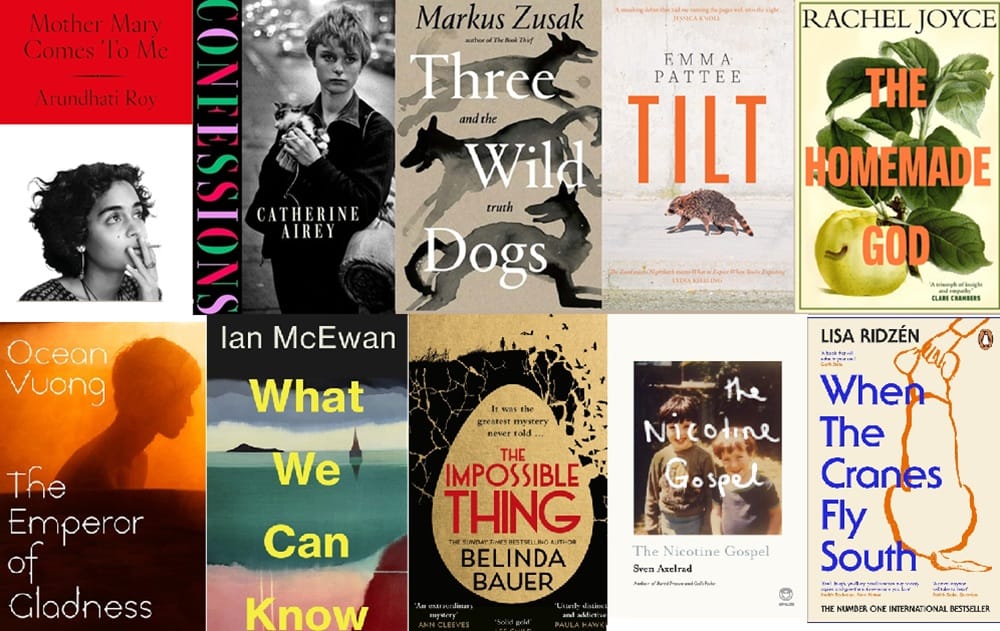
The Emperor of Gladness by Ocean Vuong
The main character, Hai, a American boy of Vietnamese heritage, struggles to process extreme pain. His first boyfriend and twin soul dies of an overdose. As Hai thinks to himself: He wanted more than one feeling at a time. As the country song goes: It’s gonna take a whole lot of whiskey to make this heartbreak go away. In Hai’s case, it’s pills.
When he is on a bridge in the rain about to jump, someone calls to him. It is an elderly woman of Lithuanian origin, Grazina, who lives on the hillside at the edge of the water. She calls him closer. Grazina is a delightful character: quirky, half-demented with bright moments and a dark sense of humour.
It’s about memories, and people who stagger under their weight.
What We Can Know by Ian McEwan
It’s a literary mystery, with plenty of heft. Thomas Metcalfe (Tom) is an academic in the year 2119. He lives in Britain, now consisting of a few islands, quite isolated – there have been global floods and major cities lie under the sea. Post-apocalyptic England, or what remains, feels not dystopian but safe, as if in a bubble.
Tom is obsessed with a poet from the previous century, a fictional writer, Francis Bundy, but really with Bundy’s wife, Vivien. He dreams and fantasizes about her to the extent that it threatens his relationship and later marriage to his colleague Rose. Vivien herself was a writer, but had become Bundy’s brilliant secretary and housekeeper at the expense of her own work.
This tightly woven novel is pure reading pleasure and reminds me why no medium grips me like the written word; on a visceral level.
The Impossible Thing by Belinda Bauer
It’s an extraordinary mystery novel. The crime in question is the theft of bird eggs. A window opens onto a world I didn’t know at all. In the hills, egg thieves gather every year to steal the remarkable eggs from the poor birds on the cliffs. The eggs are multicoloured, some have patterns, and collectors pay good money for them.
It begins in the 1920s in Yorkshire, England. The Sheppards rent an inhospitable farm and barely stay alive. The youngest, Celie, is an unforgettable character who tugs at the heartstrings. Everyone shuns her. She is small and frail and works from a young age like a laborer. There is one person who cares for her: Robert, the fool, as they call him because he never speaks. He is an orphan and more or less the family's slave. It’s humane, full of compassion and humor.
The Nicotine Gospel by Sven Axelrad
Axelrad’s third novel, The Nicotine Gospel, is set in Durban in the 1980s. Nathan, the narrator, and his brother Danny’s mother is killed on New Year’s Day by lightning, right before their eyes. Their father is an eccentric, intense writer and chain-smoker of, ironically enough, Lucky Strike. After his wife’s death, he increasingly withdraws from the world, sits late at night on the porch, enveloped in a cloud of smoke and a swarm of moths, like chaotic thoughts. He begins composing the Nicotine Gospel and preaches it to his sons, aged six and four.
The novel fills you with nostalgia for the bad old days and makes you realize again how complicated family relationships are. It’s funny, moving, and unforgettable.
When the Cranes Fly South by Lisa Ridzén
Translated from Swedish and labelled an international best-seller on the dust jacket. It’s one of those quiet, wondrous books that grip your heart, like The Book Thief. It’s full of compassion and humanity, and the sadness of impermanence.
Bo Andersson in 89. He lives in the house he grew up in and which he later inherited from his parents, together with his beloved dog, Sixten – a Swedish elkhound. They are beautiful animals that look a bit like a husky.
Bo’s son Hans is in his fifties and unhappy. He is divorced, lonely, and stressed out by work. Their relationship was never optimal and now he is the boss. He feels Bo is too old to look after Sixten and searches for another home for him. One wants to see Hans as the villain threatening Bo’s happiness, but things keeps happening that proves him right. The ending is as inevitable as death, as decay.