Blood book and toxic teens

Every now and then you open a book that is completely unlike anything you've read before. Blood Book is one such book. It is translated from German; the original title is Blutbuch. It has won German and Swiss prizes, although readers on Amazon seem to have given it only one star. I checked: Kim de L’Horizon is the pen name of Dominik Holzer, a Swiss theatre practitioner and writer.
It seizes you like a mania — the autobiographical ramblings of a distracted non-binary narrator. At the start the narrator calls themself “it” — in German, "child” is neither masculine nor feminine but neutral: Das Kind. The child grows up in the shadow of their grandmother, Grossmeer. Grossmeer is grotesque, almost like Babusha in Gerda Taljaard’s novel Die grafdigter. She is venomous and dominating. She talks without stopping. Her tongue scorches the child.
What grabs you is the rawness and, at the same time, the beauty of the prose. Consider this:
Childhood feels like a dead hare beside a dirt road that's slowly being decomposed by ants, flies, bacteria and fungi. The feeling of things disappearing, although it isn't disappearing at all, but a transformation, a translation of body to another body, of hare to worms, to flies, to world, of present to ever-present past, of stories into silence, of Grossmeer to me.
The novel, if one can call it that, is stitched together from silences, shards, splinters and negative spaces. A question that fascinates me is: how do you approach an autobiography? It so easily slips into tedium, into mere storytelling. This one is immediate, in your face, shocking and hypnotic:
I don't know how else to word it. I don't know a language for my body. I move neither in the Meer language nor in the Peer language. I exist in a foreign language. Perhaps that's one reason for this writing, for this carved-up, crumbling writing. For the fact that my hands produce only shards, their edges so splintered I can't build from them a beautiful, smooth, compelling, polished story. Perhaps writing is the search for a foreign language in the words we have available to us.
Between the lines the reader feels the silences in families — even families that never stop talking — the secrets of all that remains unsaid. Inherited trauma. A non-binary child’s struggle to inhabit their body and identity, to find a foothold in the world. The narrator has a body only when they give it away; when someone fills it. “My primary need is to feel cocks inside me, I need to feel myself, the pulsating cloak around the cocks.” They have few memories of themselves; all memory centres on the colossal figure of Grossmeer.
The novel is a broken mirror. It cuts and reflects fractured light and blood, as the title suggests. It is utterly breathtaking, like plunging into an icy mountain pool. It makes the reader see differently.
De L’Horizon spent ten years writing this astonishing book, I read on Wikipedia:
I'm searching for paths into myself, into my body memory. I've started this manuscript a gazillion times already, I've constructed plots ad nauseum. But it doesn't work, this plotting business, these already-trodden paths in the sand. The path has to emerge along the way.
This extraordinary writer avoids the well-trodden roads and carves a footpath between razor-sharp shards. I highly recommend it if this kind of manic memoir makes your heart beat faster. Le Monde calls it “wildly inventive.” I agree with the Süddeutsche Zeitung’s verdict: “Language becomes as fluid as bodies and identities: it sweeps you along in its current.”
Blood Book by Kim De L'Horizon is published by Hodder & Stoughton and costs R635 at Exclusive Books.

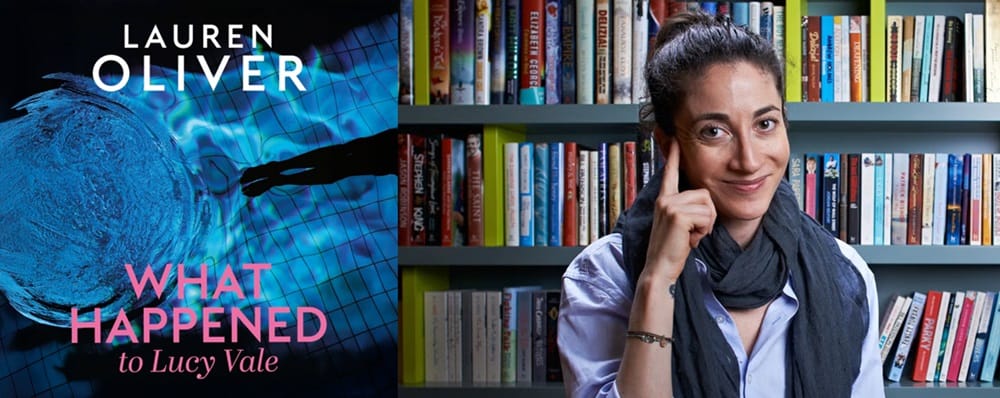
What Happened to Lucy Vale by Lauren Oliver wants to be more than a crime novel. It is a coming-of-age novel, peppered with the anxiety and uncertainty of adolescence. It is partly told by a whole group of teenagers who share their opinions on a forum under pseudonyms:
We were athletes and anarchists, band geeks and gamers, virgins and sluts. But mostly virgins. We were dyslexic, we were desperate for someone to notice us. We came from a constellation of small towns in the lower left corner of southwest Indiana, all tipped into the gravitational pull of the Woodward Central School District … We were the roughly thirty-six members of the private Discord server WoodwardSchoolBored.
They are mostly not the cool kids. Their passion is the school’s swim team, the Sharks. Championship swimmers move like gods among them and are absolved of absolutely everything.
The group is in an uproar because a new girl, Lucy Vale, and her mother move into a notorious haunted house: the house from which Veronica Faraday disappeared decades ago and where her mother killed herself. Rachel Vale, Lucy’s mother, has an agenda: She knew Veronica slightly and she is an award-winning writer: She wants to write a book about the events of the past.
Lucy has issues. When she was in elementary school, a high school boy gained her trust online and convinced her to send him nude photos of herself, which he spread far and wide. She began pulling out her hair and became anorexic. This is a fresh start for her.
Lucy indeed blossoms and becomes one of the cool kids. She catches the eye of the boy whom everyone adores: the swimmer Noah Landry. They start dating, but Rachel wonders if the relationship is healthy. Lucy develops an obsession to please Noah and obey him.
In my opinion, the conversations between the kids on WoodwardSchoolBored sometimes go on a bit too long. It’s quite lyrical, but I prefer the chapters told from Rachel’s perspective. The reader relives the minefield of teenage years and also the powerlessness of a parent watching a child find her identity.
It is very readable, but don’t wait for all the puzzles to be unravelled. A lot is suggested and left to the reader’s imagination, but what is clear is that spoiled teenage boys are toxically masculine and highly dangerous. So too the crowd who admire them from afar and so desperately want to be part of the inner circle. Jealousy soars high and hormones run wild.
What Happened to Lucy Vale by Lauren Oliver is published by Hodder & Stoughton and costs R425 at Exclusive Books.